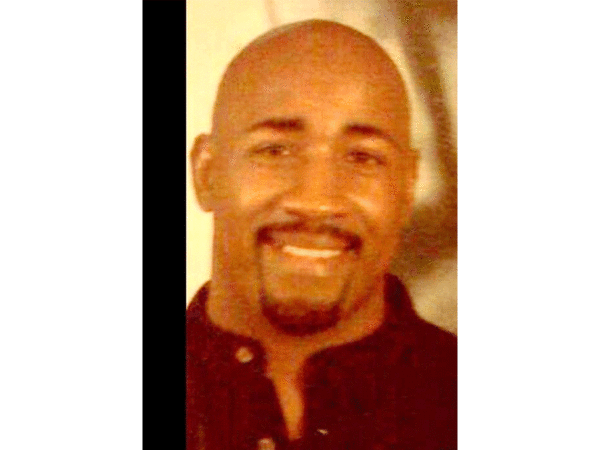
By Garry Blanson
Today in America, with the exception of the Blacks who are locked up as a result of being caught up in the American prison system, most Black People are deemed to be “Free Black” Americans. Which draws our attention to the “13th Amendment to the U.S. Constitution. You see, on January 31, 1865, the U.S. Congress passed the 13th Amendment, which was ratified on December 6, 1865. Henceforth, abolishing slavery in the United States.
However, within the Amendment, there’s a special clause in “Section One” that reads,” Neither slavery nor involuntary servitude, except as a punishment for crime whereof the party shall have been duly convicted, shall exist within the United States or any place subject to their jurisdiction.” Surprisingly, that single clause provides a “LOOPHOLE” for the continuance of slavery in America! Last year, in Louisiana, a Black State Representative proposed an amendment to the “Louisiana Constitution” to ban slavery and involuntary servitude. Sadly, after the amendment had been reworded and watered down, even the representative who proposed the amendment ended up opposing it!
Well, this week’s Black Pioneer is Scipio Africanus Jones. He was born on August 3, 1863, in Dallas County, in south Arkansas, to a 15-year-old girl by the name of Jemmina Jones. His father was an unknown white man. As a youngster, Scipio attended Negro schools near his hometown. When he turned 21, he moved to Little Rock, Arkansas, to attend Philander Smith College. In 1885, Scipio earned his bachelor’s degree from Shorter College, a Negro college in North Little Rock. After graduating, he took a teaching position in the Big Rock District.
Some of his main accomplishments included being initiated into the Prince Hall Freemasonry, passing the Arkansas Bar in 1889, and becoming the founder and owner of People’s Ice & Fuel Company, which was the only black-owned and black-operated ice manufacturing company and the only black-owned and black-operated fuel company in America. However, the accomplishment that gained him national fame and notoriety was when he represented “Over 90 Negro” defendants, including the “ELAINE 12,” who were connected to the famous “Elaine Arkansas Riot of 1919!” On March 2, 1943, Scipio Africanus Jones died and was buried at Haven of Rest Cemetery in Little Rock, Arkansas.
In closing, I would like to remind everyone that election time is very near! Therefore, make sure you are a registered voter and that your name is not on the list of people to be removed from the active voter roll in Monroe, Louisiana/ Ouachita Parish.