By Garry Blanson
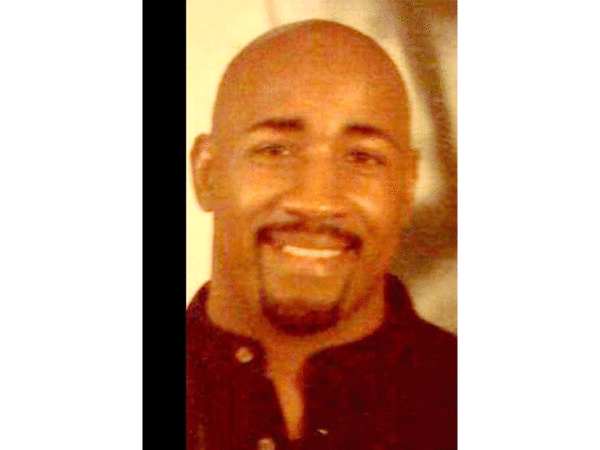
More and more each day, it seems as if we’re at the dawn of “A NEW CIVIL RIGHTS MOVEMENT” in Louisiana! Last Friday, May 10th marked the “FIFTH YEAR ANNIVERSARY” of the murder of a Black Louisiana citizen by the name of Ronald Green at the hands of Louisiana State Troopers.
On Friday, May 10th, Mona Hardin, the mother of Ronald Green, helped lead a rally at the Union Parish Courthouse, and a memorial was held later that afternoon in Monroe. Also, when we look at all of the new “Jim Crow” like bills that are being presented and passed by the Louisiana State Congress, all I can say is “DEJA VU!” Additionally, the fact that Black residents of Louisiana are underrepresented in the Louisiana State Congress doesn’t help present matters at all. Finally, there’s the unresolved issue of the congressional map. As of now, due to a federal court panel’s divided decision to throw out Louisiana’s congressional boundaries, the state is left without a map to hold the Nov. 5 election and less than two weeks to produce one before the state’s chief elections officer’s deadline to conduct a fall ballot.
Oh well, on to this week’s Black Pioneer. Abraham Lincoln Davis was born in an area of Louisiana known as Bayou Goula in 1914. Sometime between 1917 & 1921, his family moved to New Orleans, Louisiana. Young Abraham graduated from McDonough 35 High School around 1931. In 1935, he was ordained as the minister at the New Zion Baptist Church in New Orleans. Abraham went on to earn his BA degree from Leland College in 1949. Among the interesting facts about Abraham Lincoln Davis are : in 1957, he was one of the founders of the Civil Rights group known as “The Louisiana Leadership Conference,” which was a satellite organization of the SCLC organization headed by Rev Martin Luther King Jr., on September 30, 1963, he led a march of over 10,000 people, including Black & White people, on the New Orleans City Hall ; in 1975, he won the appointment race to replace a White City Councilman named Eddie Sapir, making him the first Black Man to serve on the New Orleans City Council since the “RECONSTRUCTION ERA!” Three years later, Abraham Lincoln Davis died at the age of 63.