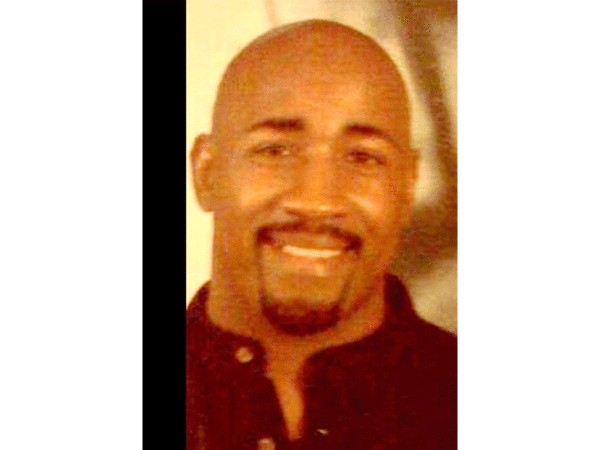
By Robert K. Wright
Every weekday morning, I face nine-year-olds who don’t know the alphabet—not for lack of potential, but because their inheritance was spent before they arrived. Meanwhile, we gather on Saturdays with signs, demanding seats at tables we aren’t yet equipped to occupy. We have confused visibility with power and performance with progress.
Booker T. Washington didn’t march; he built Tuskegee. He understood that political inclusion without an economic foundation is a house built on sand. His critics called him accommodating, but watching children struggle with the letters that open every door, his warning feels like prophecy. Similarly, Coach Eddie Robinson kept his players off the streets, knowing that excellence in a chosen lane is its own form of resistance. Preparation beats passion every time.
Dr. King’s dream assumed a self-determining people. But a people who cannot read the agenda cannot negotiate it. Having purchased my first home at forty-eight after twenty-six rentals, I finally learned how a deed changes your posture in a room. The system is designed to deliver that realization late, or never.
Today, a branded industry surrounds public protest. Visibility matters, but without institutional leverage, it is just noise. As Gil Scott-Heron noted, the real revolution isn’t televised—it happens in school boards, courtrooms, and loan offices.
In 2026, the forces aligned against us are institutional and precise. We cannot meet them with mere signs. We must:
- Build institutions and accumulate economic leverage.
- Master the law and own property.
- Prioritize preparation over performance.
The generation of the 1960s bled to open doors they weren’t sure they’d ever walk through. The least we can do is walk through them fully prepared.