Last month, City Attorney Brandon Creekbaum read a 2016 appeals court ruling into the record. The order agreed with Paster and ordered a new trial for him. He didn’t get the trial; the city dismissed the case. He says Paster’s case is over. Paster says it’s not over until former Judge Carl Sharp and attorney J. Rodney Pierre are held accountable.
For 39 years, Lester Paster has fought to get his day in court. At the Aug. 11 City Council meeting, City Attorney Brandon Creekbaum attempted to put a final period on the decades-long saga, declaring into the public record that Paster’s case is officially closed—even as Paster continues his crusade to be heard.
Addressing the council and Paster directly, Creekbaum read a 2016 ruling from the Louisiana Second Circuit Court of Appeal into the record:
“I appreciate Mr. Paster coming up to discuss this case. There is an order from the 2nd Circuit Court of Appeals that does not get discussed in Mr. Paster’s presentation. So, I want to read it. (This is an order from the Louisiana Second Circuit Court of Appeals dated October 13, 2016. The applicant Lester G. Paster has filed a motion complaining that his case arising from a 1997 charge for a violation of Louisiana Revised Statute 14401 is not proceeding as ordered by this court’s opinion in City of Monroe vs Paster [gives case citation]Whereby this court vacated the applicant’s conviction and remanded the matter to the Monroe City Court for new proceedings. Contrary to the applicants’ arguments on demand from this court, the prosecutor of the City of Monroe had the authority to dismiss the charge against the applicant. Because the charge has been dismissed, the case is final and the applicant is not entitled to a new trial. Accordingly, the applicants’ motion is hereby denied.)
Mr. Pastor’s case has been final. The charges were dismissed. The Second Circuit recognized it over a decade ago. There is no case to be tried in Mr. Paster’s case. This is the Court of Appeals order that Mr. Paster’s complaints have been violated. The Courts of Appeals itself has said it is not being violated. The case is over.”
A Victory That Won’t Clear His Name
While the city views a dismissed charge as a total legal resolution, Creekbaum’s statement only highlights Paster’s core grievance. Paster does not want the charge quietly thrown out—he wants his day in court.
By dismissing the charge altogether, the city sidestepped the original intent of the appellate court’s order for a new trial, shutting down the legal process and infuriating Paster. He maintains that getting a new trial is the only way to expose his central complaint: that no one ever had the right to enter a plea on his behalf, and that the attorneys involved should be held accountable.
Paster’s struggle began in 1987, when he was arrested three times by Monroe Police while picketing his former workplace, Auto Shack. Paster maintained the picket was legal and intended to protest racial discrimination and unfair treatment on the job.
During his first court appearance, attorney Clyde Lain, II, entered a “no contest” plea on Paster’s behalf. Paster insists he never hired Lain and never authorized the plea. From that moment forward, he argued his rights were taken without his consent. When city court officials initially dismissed his complaints, Paster appealed on his own, successfully convincing the Second Circuit Court of Appeal to set the plea aside and order a new trial—a trial he was ultimately denied when the city dropped the charges instead.
A Lifelong Fight to Be Heard
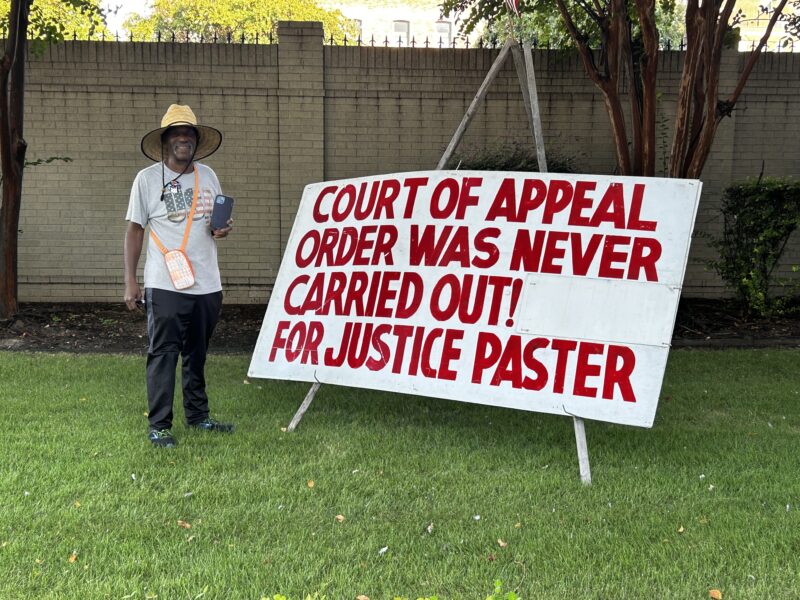
Today, Paster’s protest remains extraordinary. He posts signs along local byways and stands in front of local courthouses, practically begging law enforcement to arrest him so he can finally present his story to a jury. Yet, law enforcement will not arrest him, and the courts will not grant him the trial he insists the law requires.
Instead, his case remains frozen—noticed by the public but ignored by those with the power to act. To Paster, being ignored is worse than being arrested.
Nearly four decades after his first arrest, Paster still attends almost every Monroe City Council meeting, stepping up to the podium to plead for justice and clear his name once and for all.